
Peer Review Process
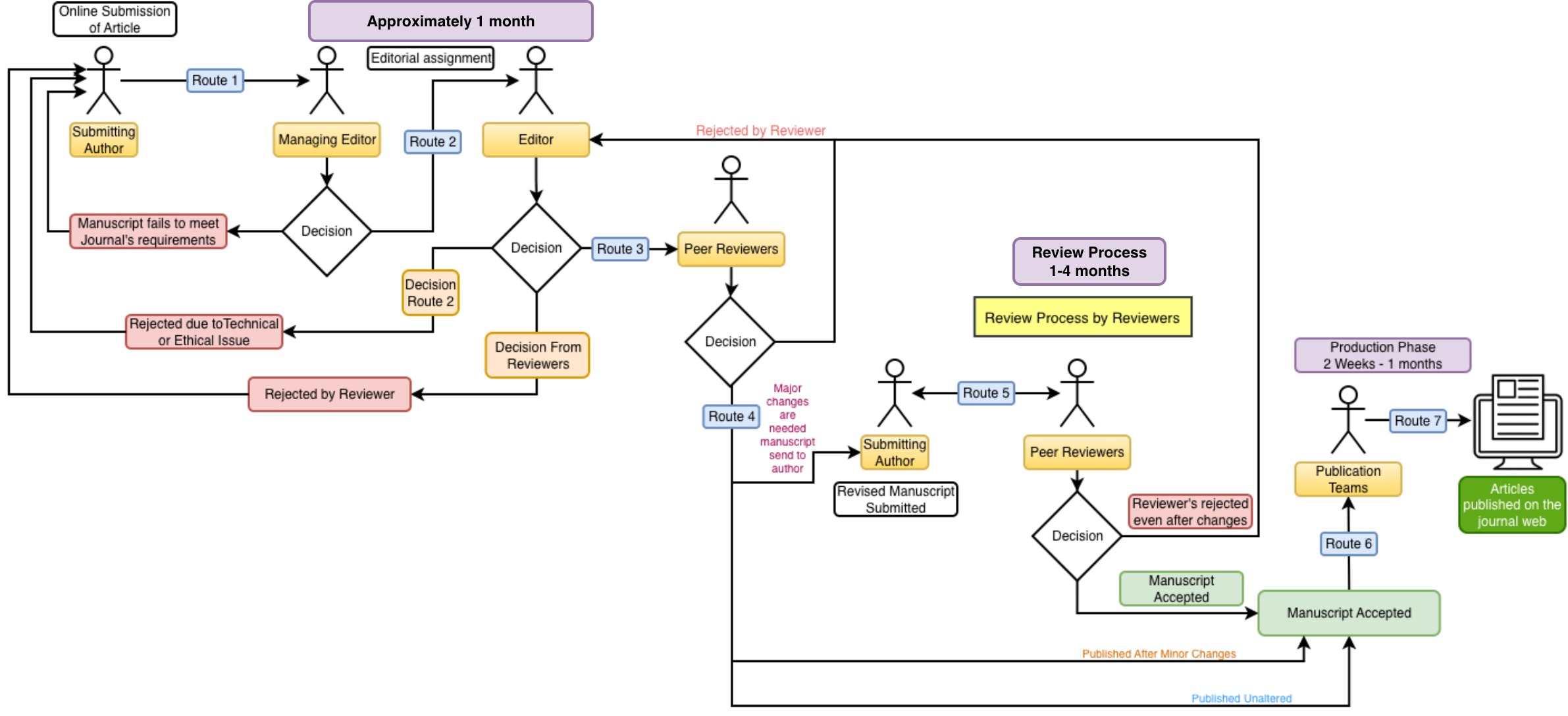
Authors must submit their manuscripts through the journal’s online submission system for consideration in journals managed by Universitas Pendidikan Indonesia. After presubmission verification, each manuscript will undergo a single-blind peer-review process. The detailed workflow is illustrated in Figure 1, and the core stages are explained below with their estimated timeframes.
1. Initial Submission and Editorial Screening
Once the manuscript is submitted (Route 1), the Managing Editor and Editor conduct an initial screening (Route 2), which typically takes approximately 1 month. This stage includes:
- checking completeness and formatting compliance,
- assessing the relevance to the journal’s aims and scope,
- evaluating novelty and scholarly contribution,
- conducting a plagiarism check using Turnitin.
Possible decisions at this stage include:
- proceeding to peer review,
- rejecting the manuscript due to scope, ethical, or technical issues.
2. Reviewer Assignment and Peer Review
Manuscripts that pass screening are assigned to a minimum of three reviewers, one internal reviewer from Universitas Pendidikan Indonesia and the remaining external reviewers. The first peer review round may take up to 4 months, depending on reviewer availability and the review process..
Reviewers assess:
- methodological rigor,
- originality and significance,
- clarity and coherence,
- ethical compliance and reporting standards.
Their reports form the basis of the editorial decision.
3. Editorial Decision and Notification
Once all reviewer reports are submitted, the Editor issues a decision (Route 5), normally within one to seven days. Possible decisions include:
- accept without changes,
- accept with minor revisions,
- accept after major revisions (conditional acceptance),
- revise and resubmit (conditional rejection),
- reject (outright rejection).
Following completion of the peer-review process (or the applicable editorial screening stage), the Editor will issue an editorial decision and communicate it to the author(s) through the OJS system and, where enabled, via email notification. Each decision category has specific implications for the workflow in OJS and determines the actions required from the author(s). The decision types and corresponding procedures are outlined below.
1) Accept without changes
The manuscript meets the journal’s scientific, technical, and ethical standards and requires no further amendments. In the OJS system, the submission is typically advanced to Copyediting/Production (or an equivalent stage, depending on the journal workflow). For this decision, no revision is required; authors proceed with copyediting and production-related requests (e.g., proofreading, layout, and metadata verification), as instructed by the journal.
2) Accept with minor revisions
The manuscript is acceptable in principle, but requires limited amendments that do not affect the core methodology or main findings (e.g., wording clarifications, formatting adjustments, citation/style corrections, minor additions to references, or small improvements to figures/tables). In the OJS system, the submission is usually marked Revisions Required (or an equivalent label), accompanied by an editorial decision letter and reviewer comments. For this decision, authors must submit (a) a revised manuscript and (b) a point-by-point Response to Reviewers addressing each comment, in accordance with the journal’s revision instructions.
3) Accept after major revisions (Conditional Acceptance)
The manuscript shows clear potential for publication, but requires substantial revisions before it can be accepted (e.g., significant strengthening of analysis, major restructuring, additional validation, or methodological clarifications). Where deemed necessary, the revised manuscript may be returned to the reviewers for reassessment. In the OJS system, the submission is typically marked Revisions Required, with a decision indicating conditional acceptance upon satisfactory completion of major revisions. For this decision, authors must provide a comprehensive revision, including a detailed Response to Reviewers and any additional files requested by the journal (e.g., a tracked-changes version), following the journal’s stated requirements.
4) Revise and resubmit (Conditional Rejection)
The manuscript is not acceptable in its current form, but may be reconsidered if it is substantially rewritten or redeveloped (e.g., fundamental improvements to contribution, framing, methodology, analysis, or overall structure). This decision typically entails a new evaluation cycle upon resubmission. In the OJS system, authors may be instructed to resubmit a substantially revised version either as a new submission or as a new round of review, depending on the journal’s policy and OJS configuration. For this decision, authors should prepare a thoroughly revised manuscript and a detailed document explaining major changes; the resubmitted version will be subject to standard editorial screening and may undergo peer review again.
A) Reject at First Screening (Desk Rejection)
The manuscript is rejected before peer review during the initial editorial screening. This may occur due to misalignment with the journal’s scope, insufficient originality or scholarly contribution, failure to meet minimum quality or formatting requirements, incomplete submission materials, or potential ethical concerns (e.g., suspected plagiarism). In the OJS system, authors will receive an email notification stating that the manuscript will not proceed to peer review (where email notifications are enabled) and/or the submission status may be moved to Archived, indicating that processing has been discontinued at the screening stage. For this decision, authors may revise the manuscript to comply with journal requirements and/or submit to a more appropriate outlet, as applicable.
B) Reject after Peer Review
The manuscript is rejected after external peer review when the concerns raised are substantial and cannot be adequately resolved within the journal’s revision framework (e.g., major methodological limitations, inadequate evidence/analysis, lack of novelty, or fundamental interpretation issues). In the OJS system, the decision will appear as Declined/Rejected (or an equivalent label), accompanied by an editorial decision letter and reviewer reports; the submission is normally closed and may subsequently be archived according to journal policy. For this decision, authors are encouraged to use the reviewer feedback to substantially improve the work before submitting to another journal, unless the journal explicitly invites resubmission as a new submission.
Direct communication between authors and reviewers, or between authors and editors regarding rejection decisions, is not permitted.
4. Revision and Resubmission Process
If revisions are required, authors are given:
- 1–2 weeks for minor revisions,
- 2–4 weeks for major revisions.
The revised manuscript must be uploaded through the submission system (Route 1) along with a detailed response-to-reviewers document. The revised version may undergo a second round of review (Route 5 → Route 4), which again takes approximately one to three months.
Each cycle of submission, review, and decision constitutes one review round, and the journal follows at least two rounds before final acceptance.
5. Final Acceptance
When reviewers and the Editor confirm that the manuscript meets publication standards, the Editor issues a final acceptance decision (Route 6). This step typically takes around one week after the final reviewer approval. In this stage, the authors are required to pay the Article Processing Charge (APC) with the amount as mentioned Terms of Payment for Article Publication.
6. Production, Galley Proof, and Publication
Once accepted, the manuscript enters the production stage (Routes 7–8), which includes:
- copyediting and proofreading,
- layout and typesetting,
- galley proof preparation and author confirmation,
- finalization for online publication.
This stage normally requires two weeks to one month before the article is officially published on the journal’s website.
| Stage | Estimated Duration | Core Activities |
|---|---|---|
| Initial Editorial Screening | ± 1 month | Scope, formatting, novelty check; Turnitin |
| Peer Review (per round) | ± 1–4 months | Single-blind review by ≥3 reviewers |
| Editorial Decision | ± 1–7 days | Decision based on reviewer reports |
| Author Revision | ± 1–4 weeks | Revision and response to reviewers |
| Second Review Round | ± 1–4 months | Review of revised manuscript |
| Final Acceptance | ± 1 week | Editor confirmation of acceptance |
| Total Estimated Duration | ± 13–38 weeks | Approximate total duration from initial screening to final acceptance |